15 February 2014

Heart of a strawberry

The strawberry crown is the heart of the plant; all the other parts (such as the leaves and roots) grow from the crown and remain attached to it. In the same way, Jesus is at the heart of the church. In him we grow and through him we are attached to one another.

A strawberry crown
A strawberry crown
What is at the heart of a strawberry? I don't mean a strawberry fruit; I mean the plant that bears the leaves and the flowers and the fruit.

If you examine a strawberry plant carefully you'll notice leaves and roots, flowers and fruit, and the runners with young plants on them. But notice something else.

Unlike many plants the strawberry has no stems and no branches. From the deepest root to the tallest leaves and the longest runners, every part is joined together in the centre.

Does this sound familiar? It should do!

The centre of church life - What is at the centre of the church? Jesus is! The heart of a strawberry plant is called a 'crown'. The leaves, the roots and the rest all spring direct from the crown. The strawberry crown rests at ground level and planting strawberries too high or too low will cause them to grow poorly or even die.

Jesus needs to be at 'ground level' in the life of the church, and everything about the church springs from him [Tweet it!]. We all inherit his nature; we all need to stay in touch with him. And being in touch with him implies that all of us will be in touch with one another also because we will all be where he is. The different parts of a strawberry plant stick out in different directions, but they are all joined to the centre. And that's exactly how we are in Christ.

And that's why, in the context of church, we must always focus on Jesus and recognise that his proper place is at the centre of everything we are and do.

Questions:

  • Is Jesus at the centre of all you think, say and do?
  • If not, who is?
  • Having everything joined to the centre keeps a strawberry plant small. Does this affect your view of church?

See also:

14 February 2014

How does a strawberry grow?

Strawberry plants reproduce vigorously by means of runners. Each year a plant can produce several more which will root themselves in the soil before the connection with the original plant is lost. If strawberry plants didn't die we would soon be inundated.

Strawberry runners
Strawberry runners
The humble strawberry is a powerful example of the explosive growth of movements [Tweet it!].

A strawberry plant is not very large. It is not tall like a tree, and it's not wide like a bush. You will rarely see a strawberry plant wider than about 30 cm or higher than 20 cm.

The plant has a small root system and a central growing point with anything up to about thirty leaves.

It is not protected by spines or thorns or poisonous compounds, it carries small flowers with white or pale pink petals, and it produces the beautiful fruit that most of us love to eat with cream in the summertime. And that's more or less it.

Oh, it also produces runners...

Here's what happens when a strawberry is planted and left alone to grow.

Runners - In late summer, strawberry runners appear as little shoots growing from the centre of the plant. At first they grow upwards, but soon begin to bend under their own weight. At the end of each runner, a small strawberry plant begins to form. Eventually the runners are long enough to touch the ground, looping up and out and down. By this time the little strawberry plants at the end of the runners have started to grow roots. These take hold in the soil and the baby plant grows. Finally the runner shrivels and dies and the new little strawberry is on its own.

And strawberry plants are very good at making runners. It's not unusual to find a runner making another runner, even before the first baby plant has taken root. In fact, this can happen several times so that the mother plant has a daughter, a granddaughter and a great granddaughter all at the same time! Not only that, the original mother plant will probably produce three or four runners, or maybe more.

Twelve months later, all these young plants will have rooted, become independent and will be producing strawberry fruit (and more runners).

Can anyone spot a parallel here with the way the church grows? It might not seem at all obvious, but it's there. Maybe there's little resemblance to church growth in terms of the institutional, denominationl systems that are all around us, but what about the early church as represented in the New Testament? Think about it!

Questions:

  • Assume a strawberry plant makes eight new plants each year. How many plants will there be after two years? (Each of the new plants and the old plant can produce eight more.)
  • How many plants will there be after three years?
  • Why doesn't church grow like a strawberry? Or does it? Can it? Should it?

See also:

09 February 2014

Fail to succeed

The secret of success is to be unafraid of failure. We may fail repeatedly on the journey to success, but if we are afraid to fail and ashamed to fail we will never experiment and so we will never reap the amazing rewards of success.

Success!
Success!
Paul Saffo is a technology forecaster in Silicon Valley.

When the BBC asked him to identify the secret of Silicon Valley's huge success, here is what he said.

The secret to Silicon Valley's success? We know how to fail and we have been doing it for decades. Failure is what fuels and renews this place. Failure is the foundation for innovation.

Failure is essential because even the cleverest of innovations - and businesses - fail a few times before they ultimately succeed.

Consider Google: at least half a dozen other companies tried to turn search into a business, but Google was the first to crack the code and turn search into a huge business.

And even when companies succeed, the only way to survive in the long term is to flee into the future by relentlessly innovating.

Church life fail? - If church in the West is to survive and flourish, we need to change the way we do things and the way we think. Church as we know it in the West has been retreating gradually for as long as I can remember. The same old ways will not do better tomorrow than they did yesterday.

How will failure help us succeed? It won't! So what does Paul Saffo mean by 'knowing how to fail'? What does he know that we don't?

It's not failure that brings success, but the willingness to fail. When the key to success is to do things differently it's essential that we experiment. Sometimes experiment fails. Perhaps it fails often. But sometimes it succeeds.

Trying new things, experimenting wildly, and not being afraid to fail - this is what has made Silicon Valley so successful. To succeed it's essential to have a dream and to run with it. And if it fails, try again with something else.

Church in the West needs to experiment madly without fearing failure. It's like surfing. Keep trying to catch the big wave. Sometimes you will miss and be left behind and will have to try again on the next wave. Sometimes you will catch it just right and be propelled forward at high speed. It will be exhilarating. The successes redeem the failures.

So if  you are involved in church life and there seems to be little or no progress, go and try a load of new ideas [Tweet it!]. When something works, run with it. You will be propelled forward at high speed and it will be exhilarating. Go for it!

Questions:

  • Which of the following strategies is most likely to succeed? Doing again what failed last time, or trying something new and untested.
  • You have never tried surfing. Do you expect to succeed or fail on your first attempt? Where will you go for advice, an experienced and successful surfer like the one in the photo or a novice like yourself?
  • Success is a common goal and driver in Western culture. Does this make it easier or harder to try out new ideas?

See also:

07 February 2014

House2House magazine

House2House magazine has interesting articles for people who follow Jesus. There's a lot of good material here, so visit the site, take a look, and decide for yourself. If you like what you see you can sign up for delivery by email. Prepare to be encouraged and challenged!

House2House Magazine
House2House Magazine is a great resource for anyone committed to life in Christ and especially (but not exclusively) for those interested in smaller forms of church gathering.

Meetings at home, in places like pubs and coffee shops, organic expressions of church, missional movements, small groups and cell groups - all of these and more will find much of interest and value in the online magazine.

House2House publishes frequent new articles on a range of church topics [Tweet it!] including hearing the voice of the Holy Spirit, growing in the journey with Jesus, encouraging one another, giving, stories from the lives of real people, spiritual gifts, reaching local people and much, much more.

History - Let me tell you a bit about the origins and history of the magazine. Some years ago, Tony and Felicity Dale launched a printed magazine of the same name. It ran for a while and was distributed world-wide in a variety of ways.

Paper publishing is in decline due to the convenience and efficiency of the internet and the web in particular. House2House eventually decided to cease publication, and a recent effort to relaunch it as a crowd-funded venture failed.

Now, however, it's available once more as an online magazine. It's free for anyone to read, is funded through donation by those who are led to do so, and is regularly updated.

Don't miss out on this great resource. Read the articles, sign up to receive new material by email, and discover what others are thinking and doing.

And if you feel brave, enjoy writing and have something to say, create an article of your own and submit it to the editors.


Questions:
  • Have you come across House2House Magazine before?
  • Do you find stories about church life interesting? Are they helpful? Do they encourage you? 
  • Would you consider writing an article and submitting it?

See also:


30 January 2014

The Railway Man

Good films tell good stories; 'The Railway Man' is a great film. This is the true story of Eric Lomax, a prisoner of war under the Japanese in Thailand, the brutality of building the Burma Railway, his later marriage and subsequent friendship with one of his Japanese captors.

The Railway Man
The Railway Man
Donna and I went to see 'The Railway Man' last night. What a film!

It stars Colin Firth and Nicole Kidman and is a marvellous story of redemption, forgiveness, freedom and life. It's based on real events and real people.

Eric Lomax (Colin Firth) is an ex-soldier. He had served in the British Army in Singapore at the time when the Japanese captured the city. As Japanese prisoners, he and his fellow servicemen suffered most terribly while constructing the railway through Thailand and Burma (the railway made famous by the film 'Bridge over the River Kwai').

Memories and freedom - Lomax was always fascinated by railways but couldn't forget or deal with his secret memories of wartime captivity and torture. He met Patti (Nicole Kidman) on a train journey in northern Britain and they fell in love. Later they married, but Eric's past haunted him until a friend discovered that Takashi Nagase (Hiroyuki Sanada), the Japanese interpreter who had assisted in his interrogation, was alive and working as a museum guide on the railway in Thailand.

Eric travels to Thailand and arrives unannounced; the two men meet and a tense exchange takes place. Through this experience Eric is able to move forward in his life. Later, when a letter arrives from Hiroyuki, Eric decides he must go to Thailand again, this time with Patti.

Some parallels - 'The Railway Man' is a great film and a wonderful story. Like all good stories it contains elements of human life at its most gripping and poignent [Tweet it!]. Wisdom, anguish, love, grace and forgiveness are all clearly portrayed.

Because of this, the story has many parallels with the greatest story of them all - the story of a powerful father who sends his one and only son to bring grace, love and forgiveness to a lost and desperate people so that darkness may be replaced by light and death may be overcome by life. These themes are eternal and significant.

Questions:

  • Have you seen 'The Railway Man'? What did you think?
  • What other films would you recommend? Do any of them provoke thoughts on deep human experiences and eternal truths?
  • All stories are worth hearing, all stories contain truth. Is this statement true or false?

See also:

21 January 2014

More soup and bread

Visiting Huntingdon with soup again, we are astonished at the way Father is leading us. We spent several hours walking and meeting people, but nobody needed or wanted soup. But just as we were about to leave we met a man on a mobility scooter and everything changed.

In Huntingdon
In Huntingdon
Following the first soup run to Huntingdon, we have repeated the exercise twice more.

On 12th January Sean went on his own as Matt and I were at Open Door in St Neots. And on 19th Matt, Kevin and I visited Huntingdon with flasks of Donna's tomato soup.

I'd better backtrack a little. Kevin is a friend from Caffè Nero in St Neots. He's part of a group of local people I've got to know quite well by visiting Nero's between 15:00 and 16:00 several times a week. With a swollen ankle and visitors over the Christmas period it's been quite a while since I was there.

Meeting on the street - I had met a group of the Nero guys in town. They were chatting in the street and I stopped to join the conversation. It crossed my mind to invite Kevin to join us on 19th, and I was amazed by his enthusiasm to come along and help with the soup run. Matt and I loaded the soup, rolls and paper cups into the car and collected Kevin from Nero's. John and Gordon were there as well and they were very supportive of Kevin.

When we arrived in Huntingdon we spent some time walking, chatting with people who were willing to talk (and a few who were not), and offering soup. We visited the river bank, a play area, the bus station, the High Street, and other parts of town. But we failed to give away a single cup of soup.

A special encounter - We sat by the fountain, warmed up our hands with some of our own cups of soup, and chatted. Just as we were considering leaving, we were making our way along the High Street and saw a man sitting on a disability scooter. Kevin was very clear and definite at this point, walking right up to the man and offering him soup [Tweet it!]. After a few moments he said he would like soup and Kevin gave him some from one of our paper cups.

Soon we began chatting about football and other things. Gerald told us a bit about himself and explained that he was waiting for his wife who was in one of the shops nearby. When she returned we chatted briefly with her too, and then I asked Gerald if we could bless him. He agreed, so we prayed a short prayer for him and for his wife before saying goodbye and heading home. Gerald wanted to shake us all by the hand before we left, there was a real connection between us.

All three of us felt we were in Huntingdon that morning specifically to meet Gerald and his wife. It's not that the walking and talking in and around the town centre wasn't good. It was good but it wasn't special. Meeting Gerald was special, and we knew it.

We don't know what will come of this. We don't know if we'll meet Gerald again. We will continue to pray for him and for his wife. And we are excited about what is happening in Huntingdon!

Questions:

  • What makes a meeting special? Is it about us, or about the person we meet, or about the Almighty who arranges our day if we are following him?
  • Matt and I almost passed by the one person we were supposed to meet in Huntingdon. But Kevin's eyes, mind and heart were wide open. What might you miss in your own life if you are not fully awake and open?

See also:


14 January 2014

Come to the mountain

What are the basic rhythms of our lives as followers of Jesus? They involve coming into his presence and going in his Name, and that, really, is all there is to it. Following Jesus is not complex or hard; he says it is easy and that his burden is light and comfortable.

The view towards Coniston
I was at a church meeting recently and The Holy Spirit gave me the words 'Come to the mountain'.

I knew that if I began by speaking these words out, the rest of the prophecy would follow, but I didn't feel it would be acceptable to just speak, and I knew that if I'd gone to the front and asked to share it, the moment would have gone and I'd have lost the flow.

There's an immediacy about prophecy that will not be denied. So I borrowed a pen and jotted the words down as they came. Here they are.

Come to the mountain. Come!

From the mountain comes your salvation.
From the mountain comes your holiness.
From the mountain comes your light.
From the mountain comes purpose, grace, glory, power, peace, love, honour, authority and hope.

Come to the mountain.

I AM that Mountain.
I AM the Rock of your salvation.
I AM dependable.
Now I say to you, go in my Name,
Go in the authority, grace, love and peace that I have poured out upon you.
Go into the world, for I AM with you.

I don't know that these would have been the words I would have spoken; they are almost certainly not. But the gist of the message is probably the same.

Coming and going - And it seems to me that coming to the Mountain and going into the world are at the heart of all that we do. Jesus says, 'Come to me everyone who is tired and struggling, I'm gentle and I'll give you rest. My load is light, the weight I lay on your shoulders is manageable and comfortable' (Matthew 11:28-30).

In coming to him we will also be gathering together. When we are where he is, we will inevitably find his other followers in that same place. We don't gather because we decide to be together, we gather around him. Moths don't gather as a cloud because they want to be together but because they are drawn to the light.

Does he send us out together? Yes he does. Jesus taught his followers to go out in twos (Luke 10:1-2). We are to go, not as a cloud around the Light who is Jesus, but in smaller groups. We do not go alone, we go in company, but we go in the company of a few.

So if we are attracted to him, we will be among many. But if we are obedient to him we will be among a few. And because we need to do both, sometimes we'll gather together and sometimes we'll go out with a few.

Basic rhythms of life - Coming into the Light and going in his Name are the basic rhythms of following Jesus [Tweet it!], they are the pattern of discipleship and missional living. These were the rhythms when he walked the dusty roads and hills of Galilee and Judaea with his followers, they were the same rhythms during the time of the early church, they are the basis of life for his persecuted people in China and Pakistan and Indonesia and many other places, and they are the same rhythms of discipleship and mission that the church in the West is beginning to rediscover.

So the call to all his people is twofold. 'Come to the Mountain' and 'Go into the world'. We are not truly following Jesus unless we are doing both. Come into his presence singing, 'Jesus is Lord'. Go into the world sharing in practical ways the good news that he is the Lord of love and of forgiveness and of freedom.

And rejoice! Again I say, rejoice!

Note: The photo was taken from near the top of Coniston Old Man, a mountain in the English Lake District. The view shows Coniston Water and the lovely little town of Coniston. Click the image for a larger view.

Questions:

  • Are you gathering around the Light? Are you going into the world? Consider if and how you do these things.
  • Is there anything you should change about your gathering and going? Pray about it.
  • When you are on a mountain you can see the country below laid out like a tapestry, you see it as a whole in a way you cannot do when you are in it. Is this significant for discipleship and mission? In what way?

See also:

12 January 2014

Sharing soup with strangers

Here's what happened when we took some tentative first steps in reaching out in Huntingdon. We enjoyed good soup, met interesting people, had some great conversations, and found that Jesus was with us and took us straight to the right places and people.


Huntingdon town centre
Back in December Sean told me that he wanted to do something positive for people on the streets.

Reading Chris Duffett's blog I'd found a story about Louise Frood, a young Baptist pioneer who had taken soup and bread onto the High Street looking for people who are hungry, lonely or willing to talk.

Sean had taken this very much to heart and wanted to do something similar. We decided there and then to put 5th January into our diaries and make a start.

Giving it a try - On Sunday 5th I drove over to Sean's with two large vacuum flasks and a pile of paper cups. Sean was already making leek and potato soup when I arrived and we filled the flasks, drove to Huntingdon, and set out to walk the streets from about ten o'clock.

It was a fresh morning, the shops were not yet open, and there were only a few people around. We walked down the High Street, looped around the back and returned. Then Sean suggested another street where he thought there would be someone selling the Big Issue and, sure enough, there was. We poured out some soup and sat on the pavement to talk, soon getting to know Richard a little and having some good conversation. We were with Richard for quite some time; when we decided to move on again he suggested we try the bus station.

Sure enough, the bus station is a warm place to go when the streets are cold and there we found Paul and Matt. Sean spent some time chatting with Paul, while I sat next to Matt and quickly discovered we had a lot in common. Matt has recently lost his job and has nowhere to live at the moment. He follows Jesus and has a similar understanding about church to Sean and me. All three of us have a strong sense that we are supposed to meet again; we are waiting to see where the Holy Spirit will lead us.

The results - Now, just a week later, Matt is using the spare room in my house and Sean is out on the soup run again. I can't make it today, but plan to be back in Huntingdon with him again next Sunday. Watch this space!

For me, the take-home message is that on our first day of obedience in taking soup to Huntingdon, Sean and I found three interesting people. A tiny amount of obedience led immediately to a remarkable result [Tweet it!]. Neither of us had the faith to expect such an outcome, both of us know we must continue whether or not amazing things like this happen every time.

In the end the outcome is not in our hands, but in Jesus' hands. He provides, he leads, he sends us but he also accompanies us. Who could want a greater guide and friend than that?

Questions: 
  • Are you willing to take a risk with your time, your money or your reputation?
  • Have you ever tried reaching people you don't already know?
  • What could you do to open up possibilities for conversation? How will you make significant contact?

See also:


30 December 2013

Food banks in the UK

Food banks are now common in the UK; many people are in difficulties because of the heavy cost of housing, ever increasing fuel bills and low income. These costs are unlikely to fall, and continuing pressure on earnings leaves many families unable to cope.

Part of the Food Bank warehouse
Food banks are operating in every part of the world, not just in the UK. Wherever the need exists volunteers are doing their best to help, but it's not always easy.

In Britain the Trussell Trust and FareShare UK make it relatively straightforward to start a local food charity.

Local action - The St Neots Food Bank in my own town was started by a group of churches in the summer of 2013 and began distributing food packages in October; they used the Trussell Trust model and have found the guidance, materials and expertise provided by them very helpful. The photo shows stored food being catalogued before being used to make up food packages for distribution.

The process - This is straightforward in principle, but needs dedicated time and effort by teams of volunteers.

  • The food is non-perishable (canned and dry products) and is donated by churches, schools, and individual shoppers via collection days at supermarkets.
  • Donated food is taken to the warehouse, weighed, labelled, sorted and stored in crates. Packages for distribution are made up in a range of sizes intended to last for three days.
  • Packages are taken to two distribution centres in the town.
  • Local organisations are given Food Bank Vouchers to give out when they become aware of a need. Voucher holders include schools, the Citizens Advice Bureau, doctor's surgeries and so forth.
  • People who have received a voucher take it to a distribution centre and exchange it for a food package.
This approach enables the Food Bank to focus on collecting, managing and providing food supplies without being involved in deciding who is in need. The voucher-holding agencies have the responsibility and necessary knowledge to do this.

Why are food banks needed? - It is, of course, right and good that churches and other groups are willing and able to provide this service to the community. And it's wonderful that the public and local businesses are willing to donate food and help in so many other ways. In St Neots a local furniture shop provides much of the warehouse and office space and additional storage has been given by another business.

But why is it necessary? Why, in twenty-first century Britain, is there a need (and, it has to be said, a steadily growing need) for food banks? [Tweet it!] There are a number of reasons and they have to do with the economy but also with government action (or lack of it, or too much of it). There has been some debate, but not enough appropriate action.

I'm not going to elaborate here, instead I'll point you to this recent article in The Guardian.


Questions:

  • Does it surprise you that food banks are becoming much more common in the UK?
  • How do you think government policy might be changed to reduce the need for them?
  • Do you think things will be better or worse in two years time?
  • Is there anything you can do to help address local needs?

See also:

25 November 2013

Reusable launchers

If Falcon 9 launches the SES-8 communications satellite successfully, this will be a doubly historic day in the life of SpaceX and for spaceflight in general. It is SpaceX's first attempt at a geostationary transfer orbit, and it's the second flight of their new partly reusable rocket.


The first Falcon 9 1.1 launch
Today is a very special day. SpaceX plans to launch its first mission to put a commercial satellite into geostationary transfer orbit (GTO).

This is what all launcher companies aspire to, and it's the core of their business.

From GTO a communications satellite can make its own way to geostationary Earth orbit (GEO), the place it needs to be if it's a TV relay or a weather satellite.

Today's projected launch is for a satellite called SES-8, flying to provide communications links for South-East Asia.

A new, reusable rocket - This is also the second launch for SpaceX's Falcon 9 1.1, a new and more powerful design that has replaced the original version of Falcon 9. Uniquely among current launch vehicles, Falcon 9 1.1 is designed to be reusable; after stage separation and ignition of the second stage and the payload, all other first stages simply re-enter the Earth's atmosphere, break up under aerodynamic stresses, and crash into the sea.

But Falcon 9 1.1 is intended to rotate, fire three of its nine engines to slow and control its descent, and finally use a single engine to land back at the launch pad. The cost savings will be immense if first stages can be re-used.

SpaceX will not attempt a return this time, though on the first flight they did so [Tweet it!] (and almost succeeded). The idea was to simulate a landing on the sea's surface and then ditch the stage.

But early next year, SpaceX would like to try again using a Falcon 9 1.1 equipped with deployable landing legs. Eventual success will transform the space launch industry very dramatically.

Watch this space! (No pun intended.)

Questions:

  • Reusable rockets would greatly reduce costs to orbit (think in terms of around one tenth the cost or less) What might cheaper access to space make possible?
  • Do you think humans will one day live in places other than the Earth? (See, for example, Mars One.)

See also: 

22 November 2013

Prayer, Bible study, story telling

Here's an opportunity for some free online training. Steve Addison presents a session on following Jesus and making disciples. It's no substitute for face-to-face contact with a trainer, but it's invaluable as a taster. If you get the chance to meet Steve, take it. But watch this and read the books anyway.

Steve Addison's website
Steve Addison is an Australian with a calling, in his own words, to 'spark church planting movements, everywhere'.

He has written some great books, 'Movements that change the world' and 'What Jesus Started' are particular favourites on my electronic bookshelf.

Steve also runs courses all over the world and is coming to Nottingham next week for the Newforms National Gathering 2013. I'll be there, and I'm greatly looking forward to hearing him.

Recently, Steve Addison released an online training video available to watch live or for download. It is an excellent starter for anyone wanting to get out amongst local people and reach them with the best news in the known universe. It focusses on prayer, simple discovery Bible study and story telling.

Read his two books mentioned above as well, you will not be disappointed by either the style or the content. They are very readable but at the same time, challenging.

Questions:

  • Watch the video. Do you think you will approach people differently from now on?
  • What single thing that you have learned will most affect the way you think and behave in future?
  • Have you ever wondered what Jesus' daily life was like? Read 'What Jesus Started' and find out. [Tweet it!]

See also:

19 November 2013

Jonestown in 1978

Thirty-five years ago yesterday, nearly a thousand people perished at Jonestown in Guyana; they committed mass suicide by taking cyanide. Just as shocking as the deaths themselves is the fact that they were persuaded to die by Jim Jones, their leader.

Jonestown from the air
Thirty-five years ago, nearly a thousand people died after drinking cyanide-laced soft drinks.

As we remember this dreadful event that shocked the world in 1978, let's ask again how it could have happened and what we need to learn from it.

The problem, at its simplest. was that too many people believed the leader of the group, Jim Jones. He told them to drink the poisoned mixture. And they did, men, women and children. The only survivors were those who had escaped beforehand.

How could it happen? - Why did so many people drink the poison? This is less easy to fathom. And how can we guard against something like this happening again?

Jim Jones was very persuasive, and he used the murders of investigators and escaping residents as a lever, telling people that the authorities would arrest them and torture them. A strong mix of anxiety, a sense of impending doom with no plausible escape, prior 'practice' sessions and calm persuasion convinced people to take the poison. And there's also the herd effect, nobody dares to be the odd one out, even when the consequences involve certain death.

Some people avoided the poisoning, a number by leaving before the fatal act took place, and a few who were away from Jonestown on the day of the deaths.

Avoiding danger - The fact that leaders can have such a major impact on their followers should cause us to consider very carefully who we choose to follow. In the church, we should be careful to follow only Jesus. Not only is that what he calls his followers to do (I am the Way, the Truth and the Life). He also loves us and never, ever calls us to harm ourselves or others.

We should be very suspicious of any church leader who issues commands, domineers, or insists on actions [Tweet it!]. Especially when those actions go against the consciences of group members. And we should be alarmed when any leader resorts to coercion or emotional manipulation.

In the case of Jim Jones' followers, it seems they were entirely well-meaning and devoted to him and his unusual mix of communist fervour and confused religious thinking. Some had the wisdom and courage to leave Jonestown, but it was far from an easy option for them.

Questions:

  • Can you think of other cases in which a leadership figure with charisma has misled people? Hint: think beyond religious leaders, include figures from the worlds of politics, business and more.
  • How would you have dealt with the Jim Jones scenario? If you had joined the movement as a young person, at what point would you have decided to leave? Read the Wikipedia article and be honest with yourself. Where do you draw the line when the line is ill-defined?
  • Is there anything we can do, individually or together, to prevent situations like Jonestown developing?

See also:

17 November 2013

Sinéad O'Connor's Theology

Sinéad O'Connor's album, 'Theology', is challenging if you listen to the words carefully. It's easy to overlook the lyrics, but they are the whole point of the album. Sometimes the words are straight from Isaiah or Jeremiah, sometimes they are her own, but always they hit home without compromise.

Theology
Theology
I wonder how many of you have listened to Sinéad O'Connor's album 'Theology'?

Like all of her music it's a little edgy. It needs to be listened to carefully and understood. Sinéad's life, her music, and her faith are all a little unconventional, but that's what makes her and her music so interesting.

It's relatively easy to be bland, perform bland music, and blandly follow where others have gone before. But to succeed in charting a new course, that's a little harder.

Above all, I'd say SinĂ©ad O'Connor does things her own way without trying to please other people [Tweet it!]. And I admire that in anyone. Much of the music and words are her own (some with Tomlinson), but she also sings pieces by Mayfield, Dowe/McNaughton, Lloyd-Webber/Rice, and a traditional piece too.

Uncompromising words - If you want to hear the music you'll need to buy the album or use Spotify or similar; but here are some of the words (partly biblical) from the track 'Something beautiful'.

I couldn't thank you in ten thousand years
If I cried ten thousand rivers of tears
Ah but - you know the soul and you know what makes it gold
You who give life through blood. Blood, blood, blood...

Oh I wanna make something so lovely for you
'Cos I promised that's what I'd do for you
With the Bible I stole, I know you forgave my soul
Because such was my need on a chronic Christmas eve
And I think we're agreed that it should have been free

And you sang to me

They dresssed the wounds of my poor people as though they're nothing
Saying peace, peace when there's no peace.
They dresssed the wounds of my poor people as though they're nothing
Saying peace when there's no peace.
Days without number, days without number
Now can a bride forget her jewels
Or a maid her ornaments?
Yet my people have forgotten me days without number...

Michael Frost and Alan Hirsch mention SinĂ©ad's album in their book 'ReJesus', and that's what got me listening. They point out that although it was part of a protest about Catholicism, there's a powerful message here for all who claim to follow Christ. They are right.

Questions:

  • Read Jeremiah 6:13-15 and Jeremiah 2:31-33. How does Yahweh feel about injustice and neglect?
  • Why is SinĂ©ad quoting these verses in her song?
  • Now read Isaiah 61:1-3 and Isaiah 61:10-11. How often do we live up to these expectations?

See also:

24 October 2013

David and Goliath

There's more than one way of understanding the David/Goliath battle. Malcolm Gladwell identifies some new twists in the story. Things may not always be as they seem at first sight. And that's true of all situations, not just those in which we think we are facing giants.

Goliath laughs at David
Malcolm Gladwell has an interesting way of looking at the famous incident of David and Goliath (1 Samuel 17:1-54).

There are elements in the story that he overlooks, especially David's reliance on Yahweh. But he closely examines some details that we might normally gloss over.

Who is Malcolm Gladwell? He is a famous thinker and author, in particular he wrote The Tipping Point, a very influential book published in 2000.

Although it's a secular book, it has many ideas useful in missional movements. In fact, it might not be stepping too far from the mark to say that the book is about missional movements - just not Christian ones in particular.

A new book - His latest work, released in 2013, is called David and Goliath and comes with the strapline Underdogs, Misfits, and the Art of Battling Giants. Watch him as he speaks at TED.


Malcolm Gladwell has clearly understood the story of David and Goliath in a different way. As he explains, we normally approach it thinking of David as the underdog. But this is not really the case; David knew exactly what he was doing.

While the story does mean what we usually take it to mean (that we should not stand in awe of a giant, but face even the most massive of issues with confidence); the real significance of Gladwell's interpretation is that it encourages us to remember that things may not always be as they seem at first sight. [Tweet it!] And that's true of all situations, not just those in which we think we are facing giants.

Questions:

  • Have there been situations in your life when you have felt small and helpless?
  • How did they work out for you?
  • How important is it to 'know your enemy'?
  • Do you think it makes a difference if you are confident? To You? To others?

See also:

22 October 2013

The blind man sees

Part 6 of a series - 'Seven signs in John'
< Walking on water | Index | No later items >

Nobody has ever done this before! Why? What happened? This rabbi with his disiples following along - he's healed a man that was born blind. He can see now, he really can see! Hmm... Sounds a bit far fetched to me. No, really, the Pharisees have checked with the guy's parents.

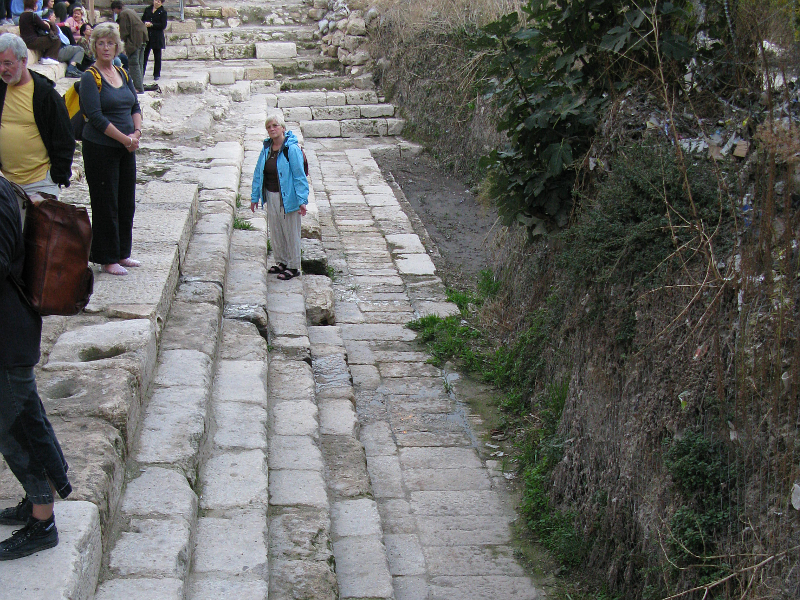
Remains of the Pool of Siloam
For the background to the signs in John and links to the other articles in the series, please read the index page.

John 9:1-41 begins with a question. The disciples would like to know why a man was born blind. Was it because of his own sins or those of his parents?

As he went along, he saw a man blind from birth. His disciples asked him, ‘Rabbi, who sinned, this man or his parents, that he was born blind?’

‘Neither this man nor his parents sinned,’ said Jesus, ‘but this happened so that the works of God might be displayed in him. As long as it is day, we must do the works of him who sent me. Night is coming, when no one can work. While I am in the world, I am the light of the world.’

After saying this, he spat on the ground, made some mud with the saliva, and put it on the man’s eyes. ‘Go,’ he told him, ‘wash in the Pool of Siloam’ (this word means ‘Sent’). So the man went and washed, and came home seeing.

His neighbours and those who had formerly seen him begging asked, ‘Isn’t this the same man who used to sit and beg?’ Some claimed that he was.

Others said, ‘No, he only looks like him.’

But he himself insisted, ‘I am the man.’

‘How then were your eyes opened?’ they asked. (more...)

Healings were by no means unknown in Jesus' day. But healing a man born blind was regarded as one of three 'Messianic miracles', one that only the Messiah would be able to do. To the religious authorities in Jerusalem it is therefore clear evidence that Jesus is, indeed, the Messiah. That's why the Pharisees wanted to check this inconvenient evidence very thoroughly.

Here are the four questions suggested by Neil Cole with some pointers for finding the answers in the material quoted above.

What does this story tell us about people? - Who was there? Well, the blind man himself of course. The disciples were there watching. We also hear about the man's neighbours and others who knew him. The Pharisees get involved and interview the man's parents. There's a lot going on and we see people with just the same attitudes and issues that we see in people today. Why do you think the Pharisees are so unwilling to accept that the man was healed?

What does it tell us about Jesus? - What did Jesus actually do? How did he heal the man? Why didn't he just say "Be healed"? Does he always do what we expect? Does he always wait for us to ask for something? (Did the blind man asked for his sight?)

What does it tell me about myself? - Are you more like the disciples, the man who was healed, the parents or the Pharisees? Maybe, in some ways, you are like them all. Who had faith in this story? How would you have reacted in the shoes of the people John describes? The blind man was obedient in what might have seemed a silly and pointless trip to Siloam. Are you obedient when you don't understand the reason?

Who else needs to hear this? - Who do you know who might benefit or be challenged or encouraged by hearing about this sign in John? Are you going to tell them?

Questions:

  • How do you think the man felt when he washed at Siloam and began to see? [Tweet it!]
  • Which triumphs in this passage, law or grace? How? Why?

See also:


< Walking on water | Index | No later items >

16 October 2013

Sciencism and religiology

Sciencism and religiology do not exist for very good reasons. Neither would be an appropriate endeavour, both would be doomed to failure. It's necessary to use faith for religion and the scientific method for science. Any attempt to swap these methods would be extremely foolish.

Science and religion
Near the end of my previous post I asked two questions, "Why is there no widespread science of 'religiology'?" and "Why is there no widespread religion of 'sciencism'?"

I'd like to consider these questions now, and we'll start with the second one.

Why is there no widespread religion of 'sciencism'? - All religions involve believing something without tangible evidence and this is called "faith". I should be clear about what I mean by "evidence". Evidence is used in a court of law to help the jury decide whether or not a person is guilty of a particular crime. This is the same kind of evidence required in science to establish whether an assumption (called an hypothesis) is wrong.

Suppose there has been a murder or a theft. The evidence that a crime has been committed is always clear, there is a body or a missing piece of property. But the evidence that the suspect was responsible is often harder to find. It might depend on discovering fingerprints or a weapon and there may be counter-evidence. Perhaps the accused has an alibi.

Science is based on clear and reproducible methods of making observations, creating hypotheses, testing them and rejecting whatever can be proved to be wrong. In some ways this is similar to a court of law. Over a period of time, often decades, if an hypothesis has still not been disproved it may be regarded as a theory, that is, an assumption that seems sturdy and has survived every attempt to prove it wrong.

That's how science works (by means of abundant evidence from observation and experiment). Because of this there is nothing to believe, science is not a matter of faith, so there can be no religious aspect to science. The religion of sciencism doesn't exist because it is a contradiction in terms. Some people might "put their faith in science" in the sense that they expect it to explain everything leaving no room for religion. But that is a dangerous point of view.

There are areas that science does not and cannot investigate. For example, the idea that there is a Creator who brought the universe into being cannot be investigated. We can observe the universe as it is today and we can draw conclusions about its state close to the beginning. But "before the beginning" makes no sense and is open to speculation and to faith, but not to experiment or measurement.

Why is there no widespread science of 'religiology'? - Let's be clear what we mean. We can use some of science's methods to study religion, but not all of them. It is possible to count or estimate the number of people who adhere to a particular faith, their geographic distribution can be studied, so can their ethnic make-up.

However, this is not enough to make a true science. Certain elements are there, but others are missing. Studies like these are part of the so-called "social sciences".  They share careful observation and hypothesis with science, but they sometimes lack the testability by experiment that is also necessary.

Suppose you form a hypothesis, perhaps that some kind of god figure is essential in a fully functioning human society, or that any god must be a feature of human imagination and cannot be real. How do you test that? What experiment can you do to disprove hypotheses of that kind?

There is no science of religiology because religion is not susceptible to the scientific method. And that turns out to be the same reason there is no religion of sciencism. (There is, however, a Journal for the Scientific Study of Religion. Perhaps this goes against the argument I am making and might be evidence that my hypothesis is faulty.)

What can we conclude? - The only sensible conclusion to draw is that we need different sets of tools for the two domains, scientific tools based on observation and experiment for science and religious tools based on faith for religion.

This is why it is incorrect to claim that evolution is as much a matter of faith as creationism. Evolution is evidence-based, creationism is faith-based. We need to use the correct tools. The creationists are right about creation and wrong about evolution. Richard Dawkins is right about evolution and wrong about creation. The two camps cannot communicate because they are using different languages.

You cannot dismiss science by claiming that faith is required. You cannot dismiss religion by claiming the scientific method is required. Both stances are equally incorrect, both are equally foolish, and both miss the point.


Questions:

  • Why do you suppose there is so much heat and so little light in the debate?
  • Do science and religion threaten one another in some way?
  • Do they deal with two different parts of the human experience?
  • If so, why can't we all just accept that?

See also:

11 October 2013

Understanding science and technology

Truth is truth, and we have to deal with that, even if it seems terribly inconvenient. In particular, scientific facts are truth in the sense that they are demonstrable (by the scientific method) and effective (because they lead to technology that works).

George Boole
George Boole
Denying something that is a well-established theory and has stood years, decades or even centuries of attempts to disprove it is, well, foolish. Yet this is often what believers do (of all faiths) when faced with a scientific finding that seems to contradict articles of their faith.

And the technologies that work for us every day include some that demonstrate the effectiveness of those disputed scientific findings.

Some examples - The science around evolution, for example, underpins some effective technologies in plant and animal breeding, agriculture and medicine.

The science of geology explains the ancient origin of rocks and the movement of the continents but also underpins the petroleum and mineral extraction industries.

And the hotly disputed science around climate change is providing predictive technologies that are already showing their worth in longer term forecasting. Although this is not a religious argument per se, it is being argued in similar ways to the conflict over evolution.

Some of the earlier science/religion debates that were once high profile are now long-forgotten. Few people would argue today that the Catholic church was correct and Galileo wrong about the earth not being at the centre of everything.

Accepting science and religion - And here's something else that's interesting. Why are certain scientific ideas argued against so vehemently while others attract little or no attention? For example, Joshua 10:12-13 tells us that the sun and moon stood still in the sky. Yet this is not leading to a mass denial of angular momentum, classical mechanics or orbital mechanics which clearly show such a thing to be impossible.

Can we not accept that science attempts to describe and explain the physical universe while religion attempts to describe and explain the spiritual realm? The physical universe is known and understood by observation, experiment, and careful thought. The spiritual realm is known and understood by revelation. Why should science and religion be seen as in conflict? Science deals with that which is provable, religion deals with that which is not.

(The photo shows George Boole, who developed the mathematics for processing values of true and false. His work underpins some of the theoretical aspects of modern computing.)


Questions:

  • Is it helpful to keep science and religion separate in our minds?
  • Why is there no widespread science of "religiology"?
  • Why is there no widespread religion of "sciencism"?
  • Does it make sense to begin with a conclusion and then look for supporting evidence? In a court of law? In science? In religion?

See also:

10 October 2013

Caring for rich and poor

How can you look after rich and poor at the same time? An imaginative organisation in Edinburgh has found a way to do just that. SocialBite is a successful experiment in selling great food while also helping the local poor and reaching needs in the third world.

SocialBite in Edinburgh
SocialBite is near the western end of Rose Street (parallel to Princes Street).

It has a small but attractive shop front and offers a range of excellent breakfast and lunch choices along with hot and cold drinks and more.

Think Pret a manger or Subway with more interest and flair and a special personal touch. You get the idea. I had a great coffee and a stunning bagel with peanut butter, banana and honey.

SocialBite is barely a year old, but plans to grow into a major chain; and these people have a special heart for the homeless and the poor.

How SocialBite works - Their profits go to charity; they are active in Scotland but also in Malawi and Bangladesh. And there's a small basket on the counter where customers can leave their change for "suspended coffee". People without money are welcome, and when the basket contains enough, they can use it for a coffee or a bite to eat.

Not only that, some of SocialBite's employees are people who have been homeless and without a clear future. Once people have an address, a job, and friends to support and encourage them, the future changes from hopeless and empty to a series of new and exciting opportunities.

Well done SocialBite, and thank you. You blessed me with an amazing bagel. I bless you in Jesus name, that you will prosper and grow and help many people in many lands.

If you haven't already watched it - go and see the video on their home page. What an awesome story!


Questions:

  • Could you do some of this good stuff where you live?
  • How about suggesting the suspended coffee idea to a business in your town?
  • How about contacting SocialBite to see if you could help begin a new branch?

See also:

21 September 2013

Cruising the gospel

Alan Hirsch urges us to cycle through the gospels as one way of keeping Jesus central in our hearts, thoughts, words and deeds. It's good advice and I've been trying it out online. Consider joining me in a trip through Matthew. After that we'll move on to Mark.

Cruising the Gospel
Cruising the Gospel
For the last couple of months I've been busy with a new project, Cruising the Gospel.

It's one of the reasons there have been so few posts on Journeys of Heart and Mind recently. So here's what I've been doing and why.

Cruising the Gospel sprang from a desire to focus more on the person, words and actions of Jesus. To this end I've been reading a short passage every day and writing some notes on what I'm discovering.

If you'd like to join me why not read along and leave comments with your own thoughts?

Forgotten Ways - Alan Hirsch in The Forgotten Ways tells us that making Jesus the centre of all we are and do is an essential element for rapid and spontaneous church growth. This is not just a matter of studying his life, it's not enough to know about him; we need to live him and breathe him and be deeply affected by him from moment to moment.

Not only that, Alan has concluded that having Christ at the centre is just one of six essential strands that we in the West have forgotten (although they remain latent in all of us and can be reactivated).

For each of the six he suggests things that we can do to influence our thinking in useful ways. Cycling through the gospels is one of these.

Come and join us. Let us know what you think. Visit Cruising the Gospelsign up for the emails, or grab the RSS or Atom feed for your favourite news reader. Join in the fun.

Questions:

  • If you don't have Christ at the heart of everything, how can you even be a disciple?
  • Other than cycling through the gospels, what else might you do to keep Jesus central?
  • Why not take a trial run in Matthew 16:13-28?

See also:

12 September 2013

Steve Addison in Nottingham

Don't miss the opportunity of hearing Steve Addison speak at the Newforms Gathering in Nottingham, 29th November to 1st December 2013. It's not too late to book, though places are going quickly.

Steve writes and speaks on missional movements, his books What Jesus Started and Movements that Change the World are excellent and have made quite an impact.

Here's what Martin Robinson (director of Together in Mission, UK) has to say about Movements that Change the World...

Steve has been tantalizing me with tales of this book for years. He has talked to me about the content on numerous occasions. The chapters are distilled from years of experience and thought, and the final product has not disappointed. Practitioners and thinkers with a passion for mission will want to read and reread this book.

Here are some things you can do right away

See you there!

06 August 2013

Gifts, prayer and needs

Leaders in the church, Part 13
< Some issues to grapple with | Index | No later items >

As we grow in living the way Jesus calls us to, we become examples for those around us, those coming next. If we live wrongly and make bad choices we will mislead others and that would be a fearful thing.

Bread of life
Bread of life
It's becoming clear to me that everything in Matthew's Gospel is of value to all believers and also to all leaders. In other words there is nothing here so far that applies only to leaders or only to followers.

Instead, the pattern is a progression, from new believer to disciple and from disciple to leader. As we learn and grow we should all aspire to guide and encourage and build those around us. Even at the earliest disciple stage we can do what Jesus' followers did; bring more people to Jesus.

We need to learn to exercise ourselves in these activities, bringing people into Jesus' presence, helping them to grow as disciples, and continuing to grow in the process ourselves. In a sense there is no distinction between leader and follower; we are, without exception, called to be both.

Giving and praying - So here in Matthew 6:1-4 we see Jesus speaking about giving to those who have insufficient and doing it secretly without show or boasting. And in Matthew 6:5-15 he tells them that it's the same for prayer. Pray privately, just between yourself and the Father. Nor is it about fancy words, the most striking thing about the prayer Jesus taught them is its simplicity. Even so, each of those simple words is loaded with meaning and significance. This is not a prayer for those who do not mean business!

Again, fasting is not for show but to be done secretly (Matthew 6:16-18).

Focussing on heaven - Matthew 6:19-24 shows how Jesus wants us to focus on heaven, not earth; to be full of light, not darkness; and to serve the Almighty, not material things.

And we are not to be anxious about food, drink, clothes or time (Matthew 6:25-34). Instead we must search for the kingdom of the Most High and for his righteousness.

By doing all these things we will become living books that people can safely follow. 'Do what I do' needs to consistently bring people right into the places where Jesus is present.

Questions:

  • If I do not give to those in need or those who ask, how will this affect my friends' understanding of Jesus?
  • Can you list some ways in which secret prayer is better than public prayer?
  • Now list the ways in which public prayer is better than secret prayer.
  • How will this affect the way you pray in future?

See also:


< Some issues to grapple with | Index | No later items >

11 July 2013

Familiar strangers

We're all aware of people we know by sight but not by name. This happens when we repeatedly see the same face in a certain context - travelling to work, having a coffee while shopping. Research shows how widespread this is; can the church make use of this idea as a missional resource?

Will I recognise anyone here?
Recent research shows that people are regularly in the same place at the same time with others they don't know.

This seems to happen because we're creatures of habit, using the same bus at the same time every day, visiting the coffee shop at the same time, using favourite shops over and over again.

Such patterns of behaviour mean that faces may become familiar to us, even if we don't know a person's name, even if we've never spoken to them. It would be easy to start a conversation with such people; if I recognise their faces they will most likely recognise mine too.

Opportunity for mission - This opens up some interesting possibilities for mission.

I'm going to try deliberately noting people that I see regularly and initiating conversations. Hopefully I can widen the circle of people I know in that way. It's going to be important to be intentionally observant so that I can find people who will feel I'm already familiar.

I'm going to pray about it and ask Father to show me the right people and guide me in the conversations. It'll be very interesting to see how this works out. This is related to the idea of a third place and using such a place as an opening for community and mission.

I don't plan to have religious conversations, just conversations about everyday things at first. As I get to know some of these people better I hope to be able to share the good news that they are loved and special in Father's sight.

Questions:

  • What places do you visit regularly? What are your daily patterns and habits?
  • Can you identify people that you see regularly?
  • Are you willing to try talking to these people?

See also:

Copyright

Creative Commons Licence

© 2002-2022, Chris J Jefferies

This work is licensed under a Creative Commons Attribution-ShareAlike 3.0 Unported License. A link to the relevant article on this site is sufficient attribution. If you print the material please include the URL. Thanks! Click through photos for larger versions. Images from Wikimedia Commons will then display the original copyright information.
Real Time Web Analytics